
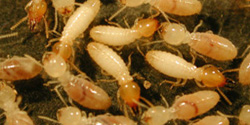
Subterranean Termites are the most common termites found in North America and the only termites we have here on Cape Cod. They date back more than 120 million years to the time of the dinosaurs. They are known as "silent destroyers" because of their ability to chew through wood, flooring and even wallpaper undetected. Each year, termites cause more than $5 billion in property damage - costs that aren't covered by homeowners' insurance policies.
Termite presence in human made structures often goes unnoticed for lengthy periods of time. A termite infested timber will appear structurally sound from the outside, while inside it will have a honeycombed appearance. Usually termites are found at, near, or below ground level. They love a moist dark damp environment - it is essential for their survival. Trim work, sub flooring, flooring, and the structural timbers are the areas of a building most susceptible to termite damage. The Subterranean Termite is considered a serious economic timber pest and it is estimated that in high activity areas, such as here on Cape Cod, more than 1 in 5 homes have been or will be attacked.
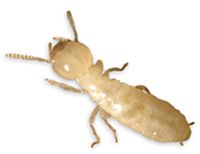
Size:
Up to 1/4 inch (12.7mm)
Description:
Termites are small, pale-colored insects. They live in colonies. The workers and soldiers do not have wings, but the fertile males and females do have long, thin wings.
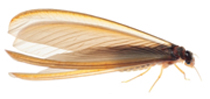 Winged Reproductives (Swarmers) are coal black to pale yellow-brown, flattened and about 1/4 to 3/8 inch long, with pale or smoke-gray to brown wings. Swarmers leave a mature colony during warm temperatures and rain. They are usually seen in late March or April here on Cape Cod. They leave their parent colony to mate and establish new colonies. They become the king and queen in the new colonies. Swarmers are matured from larger nymphs with wings. They have two pairs of long narrow wings, equal size.
 Habitat:
Subterranean Termites live in the ground and come up to feed on the wood frequently only to return back to the colony deep underground.
Termite damage is usually first seen at or near the ground. However, damage can occur far above ground if the infestation has remained undetected for a long period. Termite-damaged wood has no sawdust associated with it; but, the wood does contain mud tubes and the galleries are lined with soil. Termite damage is sometimes located in wood adjacent to heaters or fireplaces. Perhaps, the soil in these areas remains at higher temperatures during the winter, or the drainage around fireplaces is poor and the soil remains moist for long periods.
Subterranean Termites live in the ground and come up to feed on the wood frequently only to return back to the colony deep underground. The colony could contain as many as a quarter of a million termites.
Food:
Termites generally prefer to eat the cellulose in wood but this substance is also found in carpet, paper, cloth and other items in your home including PVC. They like decayed or rotting wood but do not discriminate. Termites will feed on the wood of new homes as well as the wood of an old home.
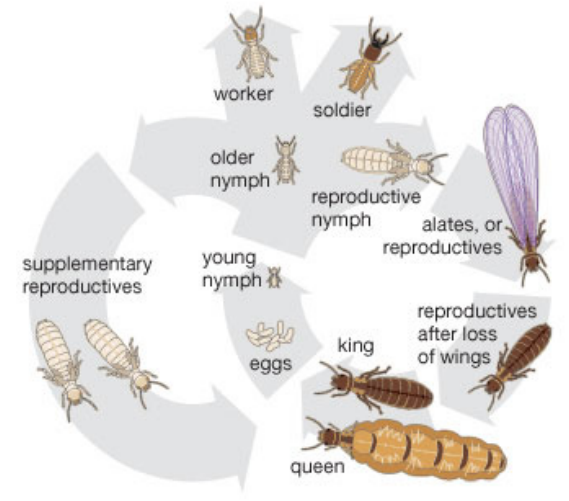 Life Cycle:
A mature queen can lay thousands of eggs each year. Eggs are tended by worker termites. The nymph hatches directly from the egg. Attendants feed nymphs regurgitated food for the first two weeks, enabling them to grow. They will become workers, soldiers, reproductives, or supplementary reproductives.
Damage:
Termites actually eat wood and can cause significant physical damage if they go undetected for long periods of time. Termites often attack wood that is touching or close to soil.
Control:
Control of subterranean termites is best left in the hands of a professional pest control operator. The application of termiticides in and around the home-around pipes, wells, and heating ducts-requires experience and the proper tools. There are also other baiting alternatives available when conventional termite treatment may not be an option.
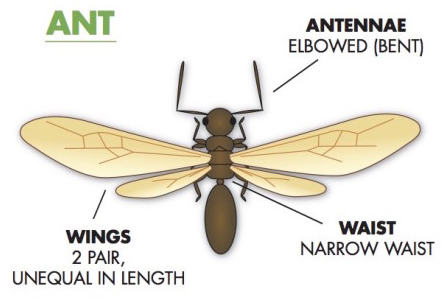
Reproductive ants are sometimes mistaken for reproductive termites that are commonly called swarmers. Ants differ from termites by having a narrow, constricted waist, elbowed (bent) antennae, and hind wings shorter than front wings.
Termites have a more rectangular shaped body with no constrictions, straight, beaded antennae and four wings of equal size and shape that are much longer than the body.
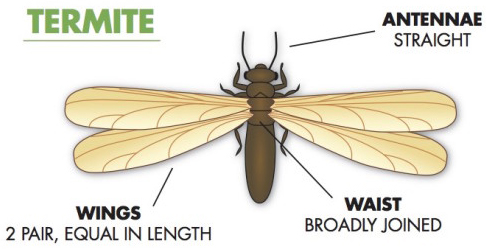
Termite wings fall off very easily and are usually found on the surface from which the termites have emerged.
Ants are commonly seen in the open, as are winged termites when they swarm. But termite workers, which are creamy white and wingless, avoid light and are rarely seen unless disturbed.
It is recommended that you have your house thoroughly inspected by a pest control professional trained to detect the sometimes subtle signs of termites.
Most swarmers emerge during the day, most frequently on warm days after rain. Swarmers found outdoors near tree stumps, railroad ties, etc., are not an indication that your house is infested but are present on the outside only. On the other hand, finding swarmers indoors often means that you have a termite infestation within your house. At first glance, swarmers and ants look similar, but can be distinguished by certain physical features. (see above)
Finding termites in a structure does not mean you have an immediate emergency because the rate at which damage occurs is relatively slow.
If you think that you may have a Termite infestation,
give
Fowler and Sons a call
508-771-BUGS
Our licensed, trained inspectors will provide a thorough, no obligation
inspection of your property
to determine
what treatment,
if any, we would recommend.


